Last Updated: January 30, 2026
AI Marketing by the Numbers (2026 Data):
- 68% of dealerships now use at least one AI marketing tool
- 45% average ROI improvement with AI automation
- 3.2x faster campaign deployment with AI tools
- $847/month average cost for comprehensive AI stack
- 62% improvement in targeting accuracy
- 18 hours/week saved per marketing team member
Why AI Marketing Tools Matter for Dealerships in 2026
Automotive marketing has reached an inflection point. The dealerships dominating their markets in 2026 aren’t simply spending more on advertising, they’re using AI to work smarter, target better, and convert faster.
The Marketing Automation Gap Costing Dealerships Sales
Traditional Dealership Marketing (No AI):
- Manual campaign creation: 8-12 hours per campaign
- Generic messaging to entire database
- No real-time optimization
- Response time to inquiries: 4-8 hours
- Conversion rate from digital ads: 2.1%
- Cost per acquisition: $847
AI-Powered Dealership Marketing:
- Automated campaign creation: 30-60 minutes per campaign
- Hyper-personalized messaging by segment
- Continuous A/B testing and optimization
- Instant response to inquiries (24/7)
- Conversion rate from digital ads: 4.6%
- Cost per acquisition: $412
The Performance Gap: AI-enabled dealerships convert 2.2x more leads at half the cost per acquisition. That’s not incremental improvement, it’s transformational advantage.
The 12 Best AI Marketing Tools for Automotive Dealerships
We’ve organized the top AI marketing tools into four categories based on functionality. Most successful dealerships use 2-3 tools minimum, often one from each category.
Tool Selection Framework:
| Tool Category | Best For | Avg. Monthly Cost | ROI Timeline | Difficulty |
| AI Chatbots & Engagement | Lead response, qualification | $200-500 | 30-60 days | Easy |
| Predictive Analytics | Customer insights, targeting | $500-2,000 | 60-90 days | Medium |
| Marketing Automation | Campaign management, nurturing | $300-1,500 | 45-75 days | Easy-Medium |
| Content Creation | Copywriting, design, video | $50-300 | 14-30 days | Easy |
Category 1: AI-Powered Customer Engagement Tools
These tools handle real-time customer interactions, lead qualification, and initial engagement, the critical first touchpoint that determines whether you capture or lose a lead.
Tool 1: AutoRaptor AI Sales Assistant
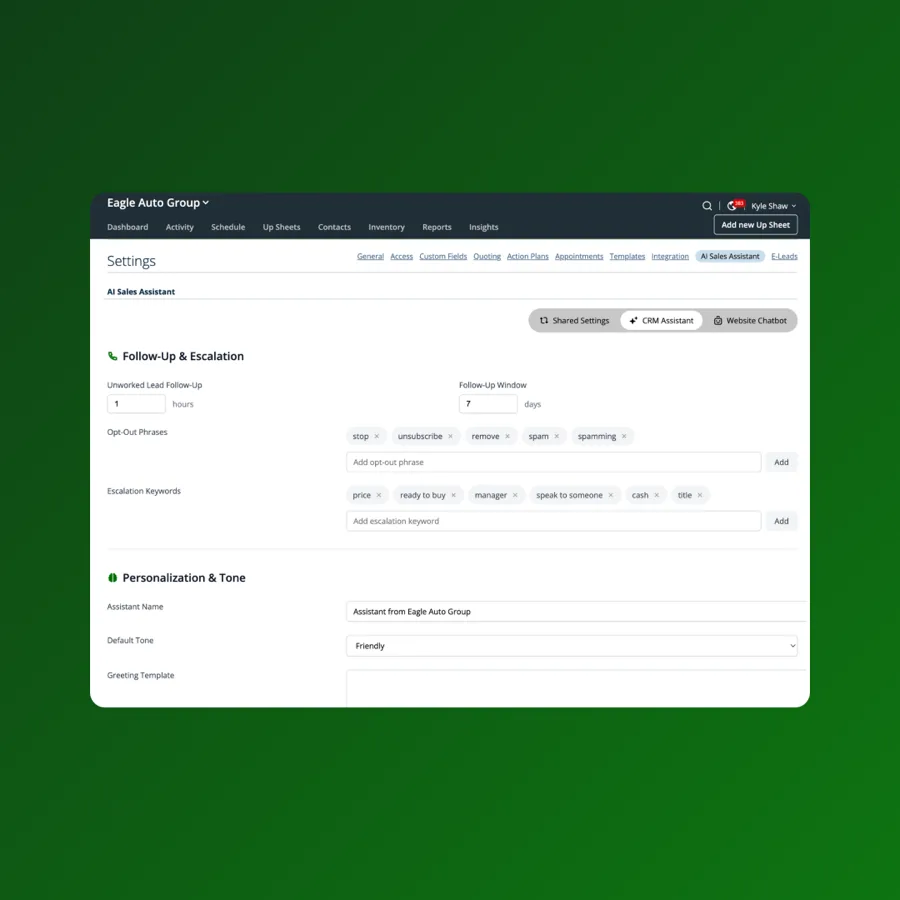
What It Does: AutoRaptor’s AI Sales Assistant is purpose-built for automotive dealerships. It responds to every inquiry within 60 seconds (24/7), qualifies leads by asking relevant questions, schedules appointments automatically, sends follow-up messages based on behavior, and seamlessly hands off to human salespeople when needed.
Why It’s Essential for Dealerships: Unlike generic chatbots, AutoRaptor understands automotive-specific contexts, trade-ins, financing, specific vehicle availability, test drives. It integrates directly with your CRM and DMS, so all customer data syncs automatically.
Key Features:
- Instant lead response across all channels (web, text, social media, email)
- AI-powered lead qualification (budget, timeline, vehicle preferences, trade-in)
- Automated appointment scheduling with calendar integration
- Intelligent follow-up sequences (personalized by behavior)
- Native integration with automotive DMS systems
- Real-time escalation to sales team for hot leads
Pricing: Included with AutoRaptor CRM ($200-300/month per user)
ROI Data:
- Average response time: 8 hours → 47 seconds
- Lead engagement rate: +127%
- Appointment bookings: +84%
- After-hours lead capture: 42% of total inquiries
- Typical payback: 18-25 days
Best For: Dealerships of any size wanting comprehensive AI lead management that works specifically for automotive retail.
Implementation Time: 2-3 weeks (setup, integration, training)
Tool 2: Drift (Conversational Marketing Platform)
What It Does: Drift specializes in conversational marketing, real-time chat that converts website visitors into qualified leads. Their AI qualifies prospects, routes conversations to the right team members, and books meetings automatically.
Why Dealerships Use It: Drift excels at capturing high-intent website visitors. If someone is browsing your inventory at 10 PM, Drift engages them instantly, answers questions, and schedules a test drive before they visit a competitor’s site.
Key Features:
- Proactive chat engagement based on behavior
- AI-powered conversation routing
- Custom chatbot flows for different scenarios
- ABM (account-based marketing) targeting capabilities
- Integration with major CRM systems
- Real-time notifications to sales team
Pricing: Starting at $2,500/month (enterprise-focused)
Best For: Larger dealerships or dealer groups with high website traffic and dedicated digital marketing teams.
Consideration: More expensive than automotive-specific solutions; requires customization for auto industry use cases.
Tool 3: Intercom (Customer Messaging Platform)
What It Does: Intercom combines live chat, chatbots, help desk, and customer messaging in one platform. Their AI handles routine questions while humans manage complex conversations.
Automotive Applications:
- Answer FAQs about financing, trade-ins, warranties
- Provide instant inventory availability updates
- Schedule service appointments
- Collect customer feedback post-purchase
- Re-engage previous website visitors with targeted messages
Key Features:
- Unified inbox (chat, email, social media)
- AI-powered resolution bot (Fin)
- Targeted messaging based on customer data
- Automated workflows for common scenarios
- Mobile apps for on-the-go engagement
Pricing: Starting at $74/month (scales with usage)
Best For: Dealerships wanting comprehensive customer communication platform beyond just lead generation.
Category 2: Predictive Analytics & Customer Insights
These tools analyze customer data to predict behaviors, identify opportunities, and optimize targeting, turning raw data into actionable marketing intelligence.
Tool 4: Google Analytics 4 with AI Insights
What It Does: GA4 is Google’s latest analytics platform with built-in AI that automatically surfaces insights, predicts customer behaviors, and identifies trends you might miss manually.
Automotive-Specific Applications:
- Predict which website visitors are likely to convert
- Identify high-value audience segments
- Forecast future inventory demand based on search trends
- Measure cross-channel attribution (which touchpoints drive sales)
- Anomaly detection (unusual traffic patterns, sudden drop-offs)
Key AI Features:
- Predictive metrics (purchase probability, churn probability, revenue prediction)
- Automated insights (surfaces meaningful trends automatically)
- Audience building with AI recommendations
- Privacy-focused tracking (cookieless future-ready)
Pricing: Free (with optional GA4 360 for enterprises at $150K+/year)
Why Every Dealership Needs It: Even if you use other tools, GA4 should be your foundation. It’s free, powerful, and integrates with everything.
ROI Impact:
- Improved targeting reduces wasted ad spend by 30-40%
- Predictive audiences convert 2.1x better than generic segments
- Automated insights save 8-12 hours/week of manual analysis
Tool 5: Tableau with Einstein Analytics
What It Does: Tableau is a leading data visualization platform. With Einstein AI (Salesforce’s AI), it provides predictive analytics, automated insights, and natural language querying of your data.
Dealership Use Cases:
- Visualize sales trends by model, trim, color, price range
- Predict inventory needs based on historical patterns
- Identify your most profitable customer segments
- Forecast monthly sales with AI-powered projections
- Analyze marketing campaign performance across channels
Key Features:
- Interactive dashboards (drill down into any data point)
- Einstein Discovery (automated predictive models)
- Natural language queries (“Which vehicles sold best last quarter?”)
- Mobile access to dashboards
- Integration with CRM, DMS, Google Analytics
Pricing: Starting at $70/user/month (Tableau Creator)
Best For: Dealerships with dedicated marketing/analytics teams who need sophisticated data visualization.
Learning Curve: Medium (requires some training but very powerful)
Tool 6: Salesforce Marketing Cloud Intelligence
What It Does: Previously known as Datorama, this is Salesforce’s AI-powered marketing analytics platform. It connects all your marketing data sources and uses AI to optimize spend, predict outcomes, and measure true ROI.
What Makes It Powerful: Most dealerships market across 8-12 channels (Google Ads, Facebook, direct mail, TV, radio, email, etc.) but can’t see the complete picture. Marketing Cloud Intelligence unifies everything and shows which combinations drive actual sales.
Key Features:
- AI-powered budget allocation recommendations
- Cross-channel attribution modeling
- Predictive campaign performance
- Automated reporting and dashboards
- Integration with 170+ marketing platforms
Pricing: Starting at $3,000/month (enterprise-level)
Best For: Larger dealerships or dealer groups spending $50K+/month on marketing who need unified analytics.
Category 3: Marketing Automation & Campaign Management
These platforms handle the repetitive work of running campaigns, email sequences, social media posts, ad management, lead nurturing, freeing your team to focus on strategy and creativity.
Tool 7: HubSpot Marketing Hub (with AI Content Assistant)
What It Does: HubSpot is an all-in-one marketing platform with robust AI features. Their Content Assistant uses AI to generate blog posts, emails, social media content, and ad copy. The platform also automates lead nurturing, email campaigns, and social media scheduling.
Why Dealerships Love It: HubSpot is user-friendly (minimal learning curve), integrates with most automotive CRMs, and provides end-to-end marketing automation from content creation to lead handoff to sales.
Key Features:
- AI Content Assistant (generates marketing copy in seconds)
- Email marketing automation with A/B testing
- Social media management and scheduling
- Landing page and form builders
- Lead scoring and segmentation
- SEO recommendations and optimization
- Detailed analytics and reporting
Automotive Applications:
- Automated new vehicle launch campaigns
- Service reminder email sequences
- Seasonal promotion campaigns (summer sales, holiday events)
- Lead nurturing for long sales cycles
- Customer loyalty and referral programs
Pricing: Starting at $800/month (Professional tier recommended for AI features)
ROI Data:
- Campaign deployment time: -74%
- Email open rates: +32% (AI-optimized subject lines)
- Lead nurturing effectiveness: +58%
- Time saved per week: 12-15 hours
Best For: Dealerships wanting comprehensive marketing automation with AI-powered content creation.
Tool 8: Marketo Engage (Adobe’s AI-Powered Platform)
What It Does: Marketo is Adobe’s enterprise marketing automation platform with advanced AI capabilities. It’s particularly strong at complex, multi-touch nurture campaigns and account-based marketing.
Advanced AI Features:
- Predictive content (AI chooses best content for each recipient)
- Send time optimization (AI determines optimal email send time per contact)
- Predictive audiences (AI builds segments based on likelihood to convert)
- Dynamic personalization (AI customizes website and email content in real-time)
Best For: Larger dealership groups with sophisticated marketing needs and dedicated marketing operations teams.
Pricing: Starting at $1,295/month (scales significantly based on database size)
Consideration: Steeper learning curve than HubSpot; requires dedicated admin/operations person.
Tool 9: ActiveCampaign (Predictive Sending & Content)
What It Does: ActiveCampaign combines email marketing, marketing automation, and CRM in one platform. Their AI features include predictive sending (determines best time to email each contact) and predictive content (shows different content to different people based on predicted preferences).
Why Smaller Dealerships Like It: ActiveCampaign delivers enterprise-level automation at SMB prices. It’s powerful but more affordable than HubSpot or Marketo.
Key Features:
- Predictive sending (AI optimizes email timing per contact)
- Predictive content (personalizes emails with AI)
- Visual automation builder (easy to create complex workflows)
- Built-in CRM (if you don’t already have one)
- SMS marketing included
- Site tracking and event tracking
Pricing: Starting at $49/month (scales with contacts; around $180-300/month for typical dealership)
Best For: Independent dealerships wanting powerful automation without enterprise pricing.
ROI Impact:
- Predictive sending improves open rates by 24% on average
- Automation saves 10-12 hours/week of manual campaign work
Category 4: AI Content Creation & Optimization
Content creation is time-consuming. These AI tools dramatically accelerate copywriting, design, and video production while maintaining quality.
Tool 10: ChatGPT/Claude (AI Writing Assistants)
What They Do: ChatGPT (OpenAI) and Claude (Anthropic) are advanced AI language models that generate human-quality written content on demand.
Dealership Marketing Applications:
Social Media Posts:
- Prompt: “Write 5 Facebook posts announcing our new 2026 inventory arrival, emphasizing variety and competitive pricing”
- Result: Instant, engaging posts ready to schedule
Blog Content:
- Prompt: “Write a 1,000-word blog post about ‘Benefits of Regular Vehicle Maintenance’ for our dealership blog”
- Result: Well-structured article covering key maintenance topics
Email Campaigns:
- Prompt: “Create a 3-email sequence to re-engage customers who haven’t serviced with us in 12+ months”
- Result: Complete nurture sequence with subject lines and CTAs
Ad Copy:
- Prompt: “Write 5 Google Ads headlines and 3 descriptions for our summer clearance event”
- Result: Multiple variations ready for A/B testing
Video Scripts:
- Prompt: “Write a 60-second video script highlighting the safety features of the 2026 RAV4”
- Result: Script with shot suggestions and talking points
Key Benefits:
- Generate content in seconds vs. hours
- Overcome writer’s block
- Create multiple variations for testing
- Adapt tone/style for different audiences
- Available 24/7, never takes a break
Pricing:
- ChatGPT: $20/month (Plus), $25/user/month (Team)
- Claude: $20/month (Pro)
Best For: Every dealership. This is the single highest-ROI AI tool for the price.
Time Savings: 15-20 hours/week for active content creators
Pro Tip: Use both. Claude excels at longer-form content and analysis, while ChatGPT has more integrations and plugins.
Tool 11: Canva Magic Studio (AI Design & Video)
What It Does: Canva is a design platform used by millions. Magic Studio is their AI suite that generates designs, removes backgrounds, creates presentations, and even produces short videos, all from simple text prompts.
AI Features:
Magic Design:
- Describe what you want: “Create a social media post for our Presidents Day sale with red, white, and blue theme”
- AI generates multiple design options instantly
Magic Write:
- Generate copy for social posts, flyers, ads directly in your design
Background Remover:
- Instantly remove backgrounds from vehicle photos (for clean inventory ads)
Magic Eraser:
- Remove unwanted objects from photos (poles, trash, distractions)
Text to Video:
- Type a script, AI creates a short video with stock footage, music, and text overlays
Automotive Applications:
- Social media posts (new inventory, promotions, events)
- Print flyers and direct mail pieces
- Digital ads (Google Display, Facebook)
- Email headers and graphics
- Event signage and banners
- Video ads for social media
Pricing:
- Free plan available (limited AI features)
- Canva Pro: $12.99/month (one person)
- Canva for Teams: $14.99/user/month
Best For: Dealerships without dedicated graphic designers who need professional-looking marketing materials quickly.
Time Savings: Create designs in minutes instead of hours (or instead of paying external designer $500+ per project)
Tool 12: Jasper AI (Marketing Copy at Scale)
What It Does: Jasper is purpose-built for marketing teams. It specializes in generating high-quality marketing copy across all formats, ads, emails, landing pages, product descriptions, social posts, blog articles.
What Makes Jasper Different from ChatGPT:
- Pre-built templates for 50+ marketing use cases
- Brand voice customization (writes in your dealership’s unique style)
- Team collaboration features (multiple users, shared brand guidelines)
- SEO optimization built-in (keyword integration, meta descriptions)
- Integration with Surfer SEO for content optimization
Automotive Marketing Templates:
- Vehicle descriptions (VDP copy)
- Email campaigns (sales, service, events)
- Social media content calendars
- Blog posts and articles
- Ad copy (Google, Facebook, display)
- Landing pages for campaigns
Pricing: Starting at $49/month (Creator plan), $125/month (Teams plan for multiple users)
Best For: Marketing teams creating large volumes of content who need consistency, speed, and quality.
ROI Example:
- Cost: $125/month for team plan
- Time saved writing content: 20 hours/month
- Equivalent hourly savings: $2,500+ at $125/hour agency rates
- ROI: 2,000%
How to Choose the Right AI Marketing Tools for Your Dealership
With hundreds of AI marketing tools available, how do you decide which ones are worth your investment?
Assess Your Current Marketing Challenges
Start by identifying your biggest pain points:
Slow lead response? → Prioritize AI chatbots and engagement tools (AutoRaptor, Drift, Intercom)
Low marketing ROI? → Start with analytics and optimization tools (GA4, Tableau)
Manual, time-consuming campaigns? → Implement marketing automation (HubSpot, ActiveCampaign, Marketo)
Struggling to create enough content? → Add AI content tools (ChatGPT, Canva, Jasper)
Not sure where problems are? → Begin with analytics (GA4 is free!) to identify bottlenecks
Start with High-Impact Tools First
Recommended Implementation Order (For Most Dealerships):
Phase 1 (Month 1-2): Foundation
- Google Analytics 4 (Free, essential for understanding performance)
- ChatGPT or Claude ($20/month, immediate content creation ROI)
- AutoRaptor AI Sales Assistant (Integrated CRM solution for lead management)
Total Month 1-2 Investment: $220-520/month Expected ROI: 3-5x within 60 days
Phase 2 (Month 3-4): Automation
- HubSpot or ActiveCampaign (Campaign automation and lead nurturing)
- Canva Pro (Design and basic video creation)
Total Added Investment: $812-1,099/month additional Cumulative ROI: 4-7x by Month 6
Phase 3 (Month 5-6): Advanced Optimization
- Tableau or Salesforce Marketing Cloud Intelligence (Advanced analytics)
- Jasper AI (Scale content production)
Total Added Investment: $445-3,070/month additional (varies widely based on tier) Cumulative ROI: 5-10x by Month 12
Integration with Existing Systems
Critical Integration Points:
Must Integrate With:
- Your automotive CRM (ideally, choose CRM with built-in AI like AutoRaptor)
- Your DMS (vehicle inventory, customer data)
- Your website (lead capture, analytics)
- Your advertising platforms (Google Ads, Facebook Ads)
Nice to Have:
- Your phone system (call tracking)
- Your social media accounts (scheduling, monitoring)
- Your email service provider
- Your payment processing system
Red Flag: If a tool can’t integrate with your CRM, it will create data silos and manual work (defeating the purpose of automation).
Before You Buy Checklist:
✓ Does it have a native integration with my CRM/DMS, or robust API?
✓ Can it sync data in real-time (not just once daily)?
✓ Does it have proven integrations with other tools in my stack?
✓ Is there documentation and support for integrations?
Implementation Guide: Getting Started with AI Marketing
Month 1: Foundation (Choose 2-3 Core Tools)
Week 1: Assessment & Planning
- Audit current marketing performance (baseline metrics)
- Identify top 3 pain points
- Set specific, measurable goals
- Research and demo 3-5 tools addressing top pain point
Week 2: Selection & Purchase
- Choose first 2-3 tools (start small!)
- Sign up for trials or purchase
- Assign team champion for each tool
- Schedule vendor onboarding calls
Week 3: Initial Setup
- Complete technical integrations
- Configure basic settings and workflows
- Import/sync existing data
- Create initial templates or campaigns
Week 4: Team Training
- Hands-on training for all users
- Create internal documentation
- Set usage expectations and accountability
- Launch first AI-powered campaigns
Success Metrics to Track from Day 1:
- Tool adoption rate (are people actually using it?)
- Time saved on manual tasks
- Campaign performance (opens, clicks, conversions)
- Lead response time
- Cost per lead, cost per acquisition
Month 2: Integration & Training
Week 5-6: Expand Usage
- Create more sophisticated workflows
- Test different AI-generated content variations
- Optimize based on first month results
- Address any technical or adoption issues
Week 7-8: Team Mastery
- Advanced training on features you haven’t used yet
- Share wins and best practices across team
- Document what’s working (playbook creation)
- Begin evaluating next tool to add
Common Month 2 Challenges:
- “People aren’t using the tool” → Add it to daily workflow, create accountability
- “Results aren’t amazing yet” → AI tools improve with optimization; give it time
- “It’s more work than manual!” → Temporary (learning curve); push through
- “We need more tools!” → Resist. Master what you have before adding more
Month 3: Optimization & Expansion
Week 9-10: Deep Optimization
- Analyze 60 days of performance data
- A/B test AI-generated content vs. manual
- Identify and eliminate bottlenecks
- Fine-tune AI settings and prompts
Week 11-12: Strategic Expansion
- Add complementary tool from different category
- Integrate new tool with existing stack
- Train team on new capability
- Document expanded processes
By End of Month 3, You Should See:
- 3-5x ROI on AI tool investment
- 40-60% time savings on automated tasks
- Measurably better campaign performance
- High team adoption and satisfaction
- Clear plan for continued expansion
Measuring AI Marketing ROI
Key Metrics to Track
Lead Generation Metrics:
- Lead volume (total leads per month)
- Lead response time (average time to first contact)
- Lead quality score (qualification percentage)
- Cost per lead (total marketing spend / leads generated)
Conversion Metrics:
- Lead-to-appointment rate
- Appointment show rate
- Appointment-to-sale conversion rate
- Overall lead-to-sale conversion rate
Efficiency Metrics:
- Time saved on manual tasks (hours per week)
- Campaign deployment speed (hours to launch)
- Content creation velocity (pieces per week)
- Marketing team capacity (leads handled per person)
Revenue Metrics:
- Marketing-attributed sales (vehicles sold from marketing efforts)
- Cost per acquisition (CPA)
- Return on ad spend (ROAS)
- Customer lifetime value (CLV) from marketing channels
Before/After Comparison Template:
| Metric | Before AI | After AI (90 days) | Improvement |
| Lead Response Time | 6.2 hours | 52 seconds | 99.2% ↓ |
| Lead Conversion Rate | 8.7% | 13.4% | 54% ↑ |
| Marketing Team Hours/Week | 42 | 26 | 38% ↓ |
| Campaigns Deployed/Month | 3 | 11 | 267% ↑ |
| Cost Per Acquisition | $723 | $447 | 38% ↓ |
Expected ROI Timeline
Month 1 (Setup & Learning):
- ROI: 0.5-1x (investment period)
- Primary focus: Training, integration, setup
- Early wins: Small time savings, initial automation
Month 2-3 (Optimization):
- ROI: 2-3x
- Performance improvements become measurable
- Team efficiency increases significantly
- Campaign effectiveness improves
Month 4-6 (Steady State):
- ROI: 4-7x
- Tools fully optimized and integrated
- Team operating at high proficiency
- Compounding benefits across all activities
Month 7-12 (Scaling):
- ROI: 5-10x+
- Adding more advanced tools
- Exponential benefits from combined tools
- Competitive advantage is significant
Benchmarking Against Industry Standards
2026 Automotive Marketing Benchmarks:
Digital Ad Performance:
- Click-through rate (CTR): 2.4-3.1%
- Conversion rate (ad to lead): 3.2-4.8%
- Cost per click (CPC): $1.80-4.50
- Cost per lead (CPL): $45-95
Email Marketing:
- Open rate: 22-28%
- Click rate: 3.2-4.7%
- Unsubscribe rate: <0.5%
- Conversion rate (email to appointment): 4-7%
Lead Management:
- Lead response time: <5 minutes (AI-enabled dealers)
- Lead-to-appointment rate: 15-22%
- Appointment show rate: 70-85%
- Appointment-to-sale rate: 25-40%
If your metrics fall significantly below these benchmarks, AI tools can help close the gap.
Common Mistakes to Avoid with AI Marketing Tools
Mistake 1: Buying Too Many Tools at Once
The Problem: “We need AI for everything!” → Buys 8 different tools simultaneously → Team overwhelmed → Nothing gets implemented properly → Tools sit unused
The Solution: Start with 2-3 high-impact tools. Master them. Then gradually add more.
Rule of Thumb: Add one new tool every 60-90 days maximum.
Mistake 2: Expecting AI to Run Itself
The Problem: “It’s AI, it should work automatically!” → No monitoring, no optimization, no human oversight → Mediocre results → “AI doesn’t work”
The Reality: AI amplifies good marketing strategy. It doesn’t replace strategy, creativity, or human judgment.
The Solution:
- Monitor AI-generated content (don’t just auto-publish everything)
- Optimize prompts and settings regularly
- A/B test AI vs. manual approaches
- Provide human oversight and quality control
Mistake 3: Not Training the Team Properly
The Problem: Tool gets purchased → Quick 30-minute demo → “Figure it out” → Low adoption → Wasted investment
The Solution:
- Dedicate real time to comprehensive training
- Create internal documentation and playbooks
- Assign tool champions who become experts
- Provide ongoing support and refresher training
- Make tool usage part of performance expectations
Mistake 4: Ignoring Integration Requirements
The Problem: Buy tool that doesn’t integrate with CRM → Manual data entry required → Creates more work than it saves → Tool abandoned
The Solution:
- Confirm integration capabilities BEFORE purchasing
- Prioritize tools with native automotive CRM integrations
- Budget time and resources for proper integration setup
- Test integration thoroughly before going live
Mistake 5: Setting Unrealistic Expectations
The Problem: “We’ll 10x our sales in 30 days with AI!” → Doesn’t happen → Disappointment → Abandon AI entirely
The Reality: AI delivers significant ROI, but it takes 60-90 days to see full benefits.
Realistic Expectations:
- Month 1: Learning curve, setup, minimal ROI
- Month 2-3: 2-3x ROI as tools optimize
- Month 4-6: 4-7x ROI at steady state
- Month 7-12: 5-10x+ ROI with expansion
Mistake 6: Using Generic Tools Instead of Automotive-Specific Solutions
The Problem: Generic chatbot that doesn’t understand “trade-in,” “test drive,” or “financing” → Poor customer experience → Lower conversion rates
The Solution: Whenever possible, choose tools built for automotive (like AutoRaptor) or can be heavily customized for automotive use cases.
FAQs About AI Marketing Tools for Dealerships
What are the best AI marketing tools for car dealerships?
The best AI marketing tools for car dealerships in 2026 include AutoRaptor AI Sales Assistant for instant lead response and automation, HubSpot Marketing Hub or ActiveCampaign for comprehensive marketing automation, Google Analytics 4 for free AI-powered analytics and insights, ChatGPT or Claude for content creation ($20/month), and Canva Magic Studio for AI-powered design and video. For most dealerships, starting with these five tools provides comprehensive AI marketing coverage at reasonable cost ($900-1,500/month total), delivering 4-7x ROI within 90 days. The key is choosing tools that integrate with your automotive CRM and DMS rather than generic solutions that create data silos.
How much do AI marketing tools cost for dealerships?
AI marketing tools for dealerships range from free (Google Analytics 4) to $20/month (ChatGPT, Claude) to $500-2,000/month for comprehensive platforms like HubSpot or Marketo. A realistic “AI marketing stack” for a typical dealership costs $800-1,500/month and includes: chatbot/engagement tool ($200-500), marketing automation platform ($300-800), content creation tools ($50-200), and analytics/insights ($0-500 for standard tools). Larger dealerships or dealer groups may invest $3,000-8,000/month for enterprise-level solutions. However, typical ROI is 4-7x within 90 days, meaning a $1,200/month investment generates $4,800-8,400 in additional monthly profit—paying for itself many times over.
Can small dealerships afford AI marketing tools?
Absolutely yes. Some of the most powerful AI tools are either free (Google Analytics 4) or very affordable (ChatGPT at $20/month, Canva Pro at $13/month, ActiveCampaign starting at $49/month). A small independent dealership can build an effective AI marketing stack for under $300/month and still see transformational results. The ROI is so strong that even one additional vehicle sale per month (generated by AI tools) more than pays for the entire investment. Many small dealerships actually benefit MORE from AI than large dealers because AI levels the playing field, giving a 5-person team the marketing capabilities that previously required 15-20 people. Start small with 2-3 core tools, prove ROI, then expand gradually.
How long does it take to see ROI from AI marketing?
Most dealerships see positive ROI from AI marketing tools within 60-90 days. Month 1 is typically setup and learning (minimal ROI, investment period). Month 2-3 brings 2-3x ROI as tools are optimized and team proficiency improves. Month 4-6 reaches 4-7x ROI steady state as tools are fully integrated and automated. By Month 7-12, ROI often exceeds 7-10x as additional tools are added and compounding benefits multiply. Quick-win tools like ChatGPT for content creation can show ROI in 14-30 days (immediate time savings), while complex analytics platforms may take 90-120 days to fully optimize. The key is setting realistic expectations: AI delivers significant returns, but they compound over time rather than appearing overnight.
Do AI marketing tools replace marketing staff?
No. AI marketing tools enhance and empower marketing teams rather than replacing them. AI handles repetitive, time-consuming tasks (data entry, routine email sends, basic content drafts, scheduling posts, report generation), which frees marketers to focus on high-value activities (strategy, creative development, relationship building, campaign optimization, analyzing insights, making decisions). In practice, dealerships using AI don’t reduce headcount—they dramatically increase output with the same team size. A 3-person marketing team with AI tools can accomplish what previously required 8-10 people, but those 3 people are essential for strategy, creativity, quality control, and optimization. Think of AI as a force multiplier, not a replacement: it amplifies human capabilities rather than eliminating them.
What’s the difference between marketing automation and AI?
Marketing automation refers to software that executes pre-defined workflows automatically (example: when someone fills out a form, send email sequence A, B, then C). It follows rules you set. AI (artificial intelligence) goes beyond automation by learning, predicting, and optimizing without explicit programming (example: AI determines which email subject line performs best, what time to send to each contact, and what content resonates with different segments—then adjusts automatically). The best modern marketing tools combine both: automation handles workflow execution, while AI continuously optimizes performance. For dealerships, this means campaigns that not only run automatically but also get smarter and more effective over time without manual tweaking.
How do I measure AI marketing effectiveness?
Measure AI marketing effectiveness by tracking four categories of metrics: efficiency metrics (time saved on manual tasks, campaign deployment speed, content creation velocity), lead generation metrics (lead volume, response time, cost per lead, lead quality), conversion metrics (lead-to-appointment rate, show rate, conversion to sale), and revenue metrics (marketing-attributed sales, cost per acquisition, return on ad spend, overall marketing ROI). The critical measurement is before/after comparison: track these metrics for 30 days before implementing AI, then compare to 60-90 days after implementation. Most dealerships see 40-60% time savings, 30-50% cost reduction per lead, 20-40% improvement in conversion rates, and 4-7x overall ROI. Use your CRM and analytics platforms to automatically track these metrics rather than manual calculation.
AI Marketing is No Longer Optional
In 2026, AI marketing tools aren’t a competitive advantage, they’re table stakes. The dealerships dominating their markets have already implemented AI across their marketing operations. Those struggling are the ones still doing everything manually.
The Reality Check:
If your dealership isn’t using AI marketing tools, you’re competing against dealers who are:
- Responding to leads 100x faster
- Deploying campaigns 3x more quickly
- Converting leads at 2x higher rates
- Spending 50% less per acquisition
- Creating content 10x faster
That’s not a level playing field.
But Here’s the Good News:
AI tools are more accessible and affordable than ever. You don’t need a massive budget or technical expertise. You need commitment to implementation, willingness to learn, and 60-90 days to see results.
Your Next Steps:
- This Week: Sign up for ChatGPT ($20/month) and create your first AI-generated campaign content
- This Month: Implement Google Analytics 4 (free) to understand your baseline performance
- Next 30 Days: Demo automotive-specific AI tools (start with AutoRaptor if you need full CRM+AI solution)
- Within 90 Days: Have 2-3 core AI tools fully operational and delivering measurable ROI
The question isn’t whether to adopt AI marketing tools. It’s whether you’ll lead or follow.
Experience AI-Powered Marketing with AutoRaptor
AutoRaptor’s comprehensive automotive CRM includes built-in AI marketing automation: instant lead response 24/7, intelligent follow-up sequences, email and SMS marketing automation, predictive lead scoring, and campaign performance analytics.
See it in action:
Frequently asked questions
Questions About This Topic
What makes AutoRaptor's AI Sales Assistant well-suited for car dealerships?
Unlike generic chatbots, it understands automotive-specific contexts like trade-ins, vehicle availability, and test drives, and it natively integrates with automotive DMS systems so customer data syncs automatically with a dealership's existing systems.
How is AI changing lead response times for car dealerships?
AI-powered tools let dealerships respond to inquiries instantly and around the clock, replacing response times that could otherwise stretch for hours with automated engagement that qualifies leads and books appointments as soon as a customer reaches out.
What role does Google Analytics 4 play in a dealership's AI marketing stack?
GA4 uses built-in AI to automatically surface insights, predict which website visitors are likely to convert, identify high-value audience segments, forecast inventory demand from search trends, and measure which marketing touchpoints actually drive sales.
What is a common mistake dealerships make when adopting AI marketing tools?
A common mistake is buying too many tools at once, which overwhelms the team and stalls proper implementation. A better approach is to start with two or three high-impact tools, master them, and gradually add new capabilities every couple of months.
What's the difference between marketing automation and AI for dealership marketing?
Marketing automation executes predefined workflows, like sending a set email sequence after a form fill, while AI learns, predicts, and optimizes without explicit programming, such as determining the best send time or content for each contact and continuously improving results over time.